Program Handbook

The program, start to finish.

Winter Park FFA is new. It is not improvised. What follows is the full architecture of the program — the courses, the competitive teams, the standards we hold ourselves to, and the vocabulary you will hear in the first week — set out plainly enough that a family can evaluate it and a student can walk in on day one already knowing how it works.

The program Courses What officers do The words Official Dress Conduct Questions

The Program

Agricultural education is a career pathway, not a club.

Official FFA emblem

Agriculture is the largest industry in Florida and one of the largest in the world, and the field spans veterinary science, biotechnology, food science, environmental systems, engineering, business, and design. Students in this program are not picking up a hobby. Florida designates FFA as the Career and Technical Student Organization for both of these programs — the co-curricular half of a state career-preparatory pathway, not an after-school club attached to it. What happens in the chapter is the applied half of the coursework.

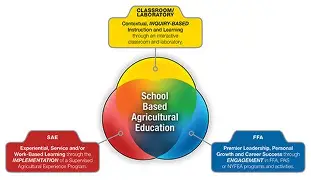
Agricultural education has three parts, and you get all three:

  • The classroom and lab. The actual course you're enrolled in during the school day.
  • FFA. The competitions, the conferences, the leadership, the trips, the jacket. What most people picture.
  • Your SAE. Your own hands-on project outside of class — a job, an animal, a business, a research plot.

You can't really do one without the others, which is why officers have to stay enrolled in an ag course all year. It isn't red tape — the class is the thing the rest hangs off of.

No agricultural background is required or expected. The majority of FFA members nationally have never lived on a farm, and the program was rebuilt decades ago around that fact. This chapter is designed for the students who are actually at Winter Park — and a student with no prior exposure is not behind anyone.

Course Sequence

Two state career-preparatory programs, one entry point.

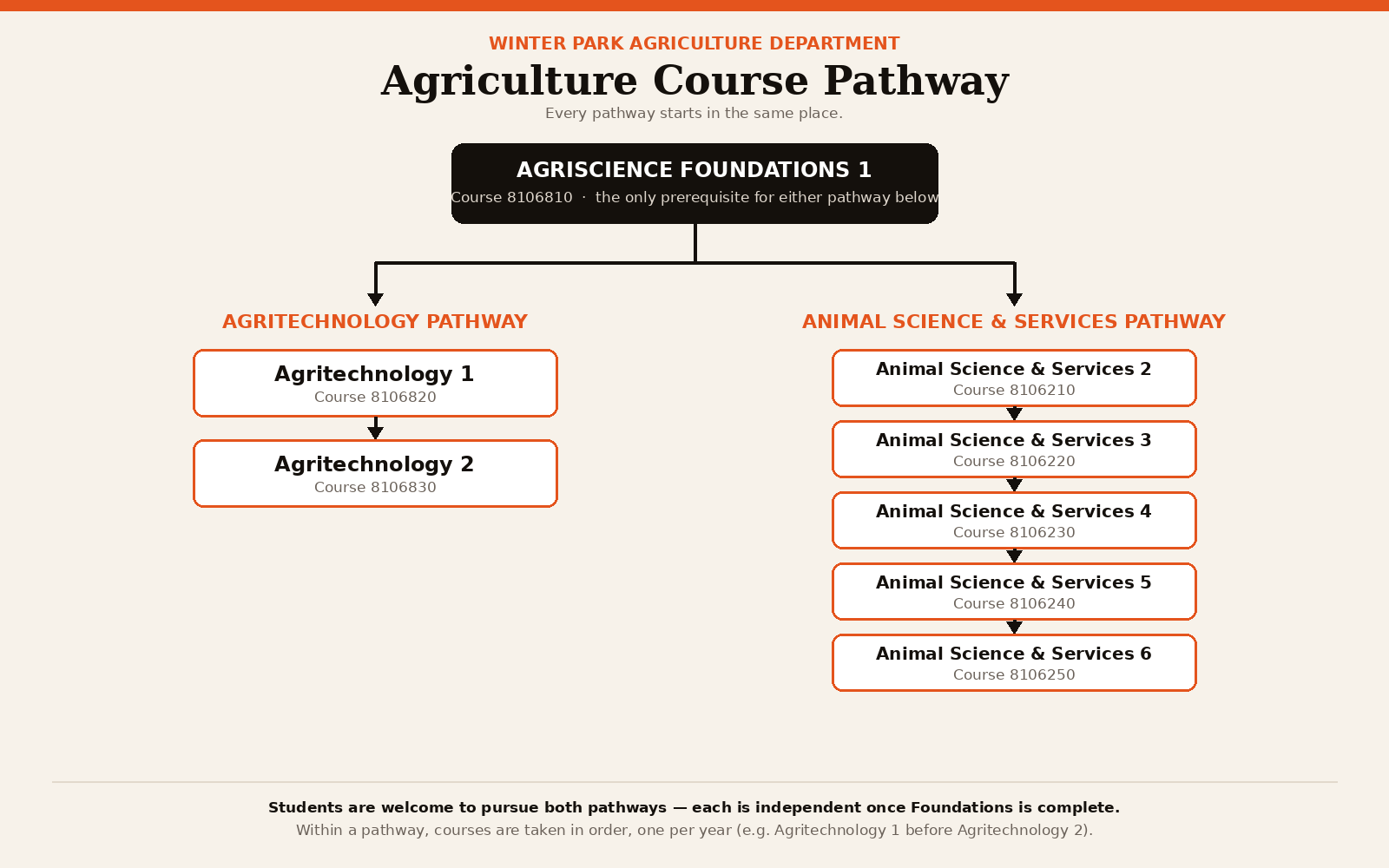
These are not locally invented electives. Both are Florida Department of Education Career and Technical Education programs in the Agriculture, Food and Natural Resources cluster, with state-defined standards, industry alignment, and a defined course sequence. A student who starts as a freshman can finish with a coherent six-credit body of work.

Agriscience Foundations 1  Course 8106810 · 1 credit

The entry course for both programs. Agricultural history and global impact, career pathways, scientific reasoning and research design, biological and physical science principles, environmental systems, laboratory safety, leadership, and agribusiness. At least twenty percent of class time is laboratory work.

Counts as Equally Rigorous Science. This course satisfies a science graduation requirement — it does not merely occupy an elective slot.

Animal Science & Services  Program 8106200 · up to 6 credits

A five-course sequence following Foundations. Anatomy, physiology, nutrition, genetics, and health across livestock and companion animals, alongside production management, finance, safety, and the correct use of animal health-care, grooming, restraint, and laboratory equipment.

Feeds: veterinary science, livestock, poultry, and dairy competition — and the fair show ring.

Agritechnology  Program 8106800 · up to 3 credits

A two-course sequence following Foundations. Plant and animal production and processing, agricultural mechanics, marketing, and the biological and physical science behind them — with the laboratory and technology practice that supports agricultural and food science technician work.

Feeds: floriculture, nursery and landscape, agronomy, environmental science, and food science competition.

The SAE is a state requirement, not a chapter tradition. Every student in these programs must complete a Supervised Agricultural Experience — through career exploration, directed laboratory work, project ownership, an internship, a school-based enterprise, or service learning. It is written into the framework, and it is the piece that turns coursework into something a college or an employer can see.
Enrollment is the one requirement for membership. A student must be enrolled in an agriculture course to hold membership, compete, or serve as an officer. If the course is not on a schedule yet, request it — that is the single step that runs on a timeline the chapter does not control.

The Officer Team

What each job actually involves.

Pick based on what you want to get better at, not on which title sounds most impressive. Every one of these is real work, and in a first-year chapter every one of them matters more than it would somewhere established.

President

Runs the meetings, keeps the team pointed the same direction, and speaks for the chapter to the school and the community.

Best fit if: you're comfortable being the one people look at when something needs deciding.

Vice President

Owns the committees and the calendar. Makes sure the things we said we'd do actually get assigned to someone. Steps in when the president can't.

Best fit if: you're organized and you like making plans real.

Student Advisor

Ranked directly under the vice president. The Student Advisor mentors newer members, carries the general membership's perspective into officer meetings, and advises the president and vice president — the officer whose job is to tell the team what it does not want to hear. In an established chapter this seat usually goes to a past officer; in year one it fits a student arriving with middle school FFA experience.

Best fit if: people already come to you for advice, and you will say the hard thing out loud.

Secretary

Minutes, membership records, correspondence, and the chapter's paperwork. In a brand-new chapter, the secretary is building the filing system that every future officer will use.

Best fit if: you're detail-driven and you actually finish things.

Treasurer

Dues, fundraisers, the budget, the receipts. Real money, tracked carefully, reported to the chapter.

Best fit if: numbers don't scare you and you're trustworthy with other people's money.

Reporter

Social media, the newsletter, photos, the school announcements. If nobody knows what we did, it may as well not have happened — that's the reporter's problem to solve.

Best fit if: you already make content and you have an eye for a good photo.

Sentinel

The room itself — setup, cleanup, equipment, and greeting people at the door. The sentinel is the reason a nervous freshman isn't standing alone at their first meeting. Quietly one of the most important jobs on the team.

Best fit if: you notice when someone's on the outside of a group.

Historian

Builds the record of a chapter that doesn't have one yet — photos, scrapbook, the story of year one. Everything you save becomes the chapter's history permanently.

Best fit if: you're creative and you think in pictures and stories.

Parliamentarian

Keeps meetings orderly and fair using parliamentary procedure — the rulebook groups use to make decisions without it turning into an argument. Also the officer most likely to end up on a competitive parliamentary procedure team.

Best fit if: you like rules, structure, and being the person who knows how it's supposed to work.

The three committee chairs.

Beyond the traditional offices, this chapter seats three committee chairs — one for each division of the National Chapter Award, the national standard by which FFA chapters are evaluated. Structuring the officer team this way from year one means the chapter's Program of Activities is built to that standard from the first meeting rather than assembled retroactively.

Growing Leaders Chair

Owns everything directed at the members themselves: leadership development, scholarship and academic support, healthy lifestyle activities, personal growth, and career readiness.

Best fit if: you think about what the people around you need in order to get better.

Building Communities Chair

Owns everything directed outward: community service, environmental projects, citizenship, relationships with stakeholders, and economic development work.

Best fit if: you want the chapter to be visible and useful outside the ag building.

Strengthening Agriculture Chair

Owns everything directed at the industry: agricultural advocacy and literacy, safety education, chapter recruitment, and the support groups — parents, alumni, and industry partners — that a program depends on.

Best fit if: you can explain why this field matters to someone who has never thought about it.

Chairs plan and document real events. Each division covers five activity areas, and each activity is recorded with a stated goal, a planned impact, and a measured actual impact. That documentation is the National Chapter Award application. It is also, not incidentally, exactly how project management works everywhere else.

Glossary

The words people will use around you.

Nobody will explain these. They'll just start saying them. Here they are in plain English.

SAE — Supervised Agricultural Experience
Your own hands-on agriculture project outside of class. Raising a show animal, working at a vet clinic or nursery, growing something to sell, running a lawn-care business, or a research project all count. Every member is expected to have one, and it's how you earn degrees.
CDE — Career Development Event
A team competition in an actual agricultural skill: livestock judging, forestry, floriculture, agricultural mechanics, food science, and dozens more. Most people just call these "contests."
LDE — Leadership Development Event
The speaking and meeting side of competition: public speaking, job interview, opening and closing ceremonies, parliamentary procedure. These are the ones that make you better at things you'll use for the rest of your life.
Official Dress
The uniform worn at competitions and formal events. Required for officers. Full details in the next section.
Degrees
Levels you earn as you go. Greenhand is the first — you learn the Creed, the emblem, and the Code of Ethics, and submit a short application. Chapter Degree takes real work: a running SAE, community service hours, leading a discussion, and demonstrating parliamentary procedure. State and American take years and are a serious achievement.
The FFA Creed
A short piece written in 1928 that members learn and recite. Reciting it is its own competition for first-year members, and it's usually the first thing a new member memorizes.
Program of Activities (POA)
The chapter's plan for the year — what we're doing, when, and who's responsible. The officer team writes it. This year we're writing the first one that has ever existed here.
Chapter, Federation, District, State
Nested levels of organization. Chapter is us. Federation groups the chapters in Orange County. District is bigger, then State, then National. Competitions generally start at one level and advance up.
Official Manual
National FFA's handbook — ceremonies, degree requirements, history, and the Code of Ethics. Every member should have access to one.
Greenhand
A first-year member. Not an insult — it's an actual degree with a pin.

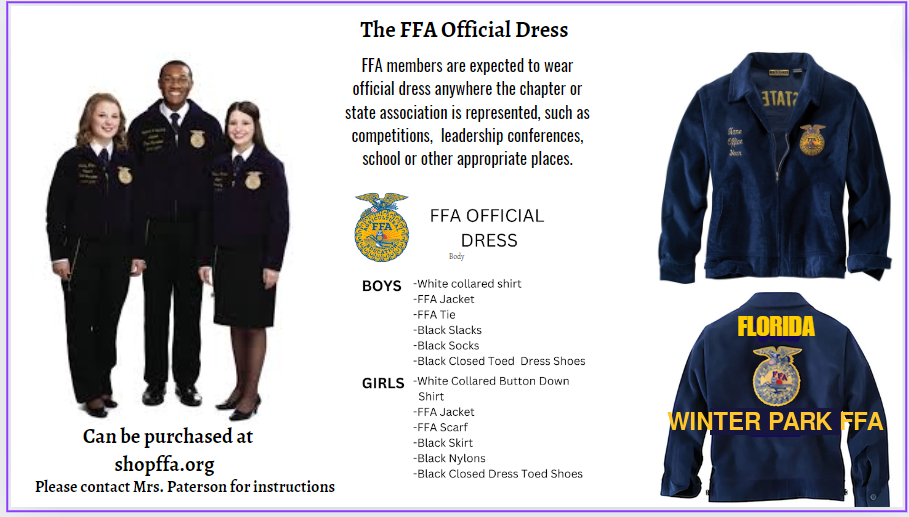
Official Dress

Required, and worth getting right.

For officers this is mandatory at every competition, banquet, and formal chapter function. It's identical nationwide, which is the point — 900,000 members in the same jacket is a powerful thing to stand inside of.

  • The official FFA jacket — blue corduroy with your name and chapter on it. Worn zipped all the way to the top, collar turned down, cuffs buttoned.
  • A white collared shirt or blouse, with the official FFA tie or the official FFA scarf.
  • Black slacks with black socks, or a black skirt with black nylons.
  • Black dress shoes with a closed heel and a closed toe. This is the rule that catches people every single year — no sandals, no open-toe flats, no boots. Check your shoes the week before, not the morning of.
Official garb of a recognized religion may be worn with Official Dress, and required personal protective equipment may be worn as well. If you have a question about how this works for you, ask me directly and we'll sort it out.

What it costs: the jacket runs around $75. Most students already own black pants and a white shirt, and where they don't, those are inexpensive.

Nobody misses out over money. The chapter fundraises for jackets and keeps a loaner rack. If cost is a concern in your house, apply anyway and email me — that conversation stays between us and it has no effect on selection.

Day to day, officers wear a chapter polo and khakis. Far less formal, and the chapter provides the polo.

Conduct

What we expect of each other.

National FFA publishes a Code of Ethics that every member agrees to. Here's what it comes down to, in ordinary language — and it applies to members, and doubly to officers, who agreed to be examples.

  • Dress for the occasion and take care of the jacket. It represents more people than just you.
  • Be courteous and respect other people's rights — including people you don't like and chapters you're competing against.
  • Be honest. Don't take unfair advantage of anyone, in the show ring or out of it.
  • Respect other people's property and the school's.
  • Watch how you speak to and about people, in person and online. Officers especially: what you post is chapter business.
  • Show up on time, participate, and respect opinions you disagree with.
  • Demonstrate real sportsmanship when you win and when you lose.
  • Take pride in this organization and in agriculture as a career field.
  • Share what you learn with the members coming up behind you.
  • Appreciate and promote diversity in this organization. Everyone gets a seat here.

Members are also expected to refrain from tobacco and alcohol while underage and at all times when representing FFA, and to help discourage that behavior in others.

The short version: when you're in the jacket, you are the whole chapter as far as anyone watching is concerned. Act like it. That's the entire job.

Questions

What families ask.

My child has never done anything like this. Are they behind?
No. This chapter is in its first year, so nearly everyone is starting at the same place at the same time. That's genuinely unusual and it's the best possible moment to walk in.
Do we need land or animals?
No. Plenty of members never show an animal at all — they compete in speaking, food science, floral design, mechanics, or forestry. For students who do want to show, we can usually work out housing an animal, so ask before assuming it's off the table.
What does it cost?
Membership dues are modest and set each year. The jacket is the largest single cost at roughly $75, and the chapter fundraises for jackets and keeps loaners. Trips and shows vary and are always announced well ahead with fundraising attached. No student is turned away over money — email me and we'll handle it privately.
How much time does this take?
A regular member: a monthly meeting plus whatever activities they choose. An officer: meetings, planning, events, and the retreat — a real commitment, and one reason the application asks so directly about everything else on your plate.
Can my child do this alongside a sport or band?
Usually yes, and many do. The application asks about conflicts specifically so we can plan around them honestly rather than discovering them in October.
My eighth grader is coming to Winter Park next year. What should they do now?
Request an agriculture course when they choose classes — that's the one thing that has to happen on a schedule we don't control. Everything else can be sorted out once they're here.
What happens at the officer interview?
Interviews run after school on Thursday, August 20, starting at 3:00. It's a panel interview — industry professionals and school administrators, rather than one person alone. Your student gives a prepared speech of up to five minutes (two or three is plenty), then the panel asks a round of questions. It's short, there are no trick questions, and "I don't know, but here's how I'd find out" is a perfectly good answer. Practicing the speech out loud to an actual person twice beforehand is the whole secret.
Does my child have to be an officer to be involved?
Not at all. Officers are a handful of people. The chapter is everyone. Members compete, travel, and earn degrees exactly the same way.

Still have questions?

Ask. There is no question about this that's too basic, and I would much rather answer it now than have you sit it out.

Apply to be a founding officer